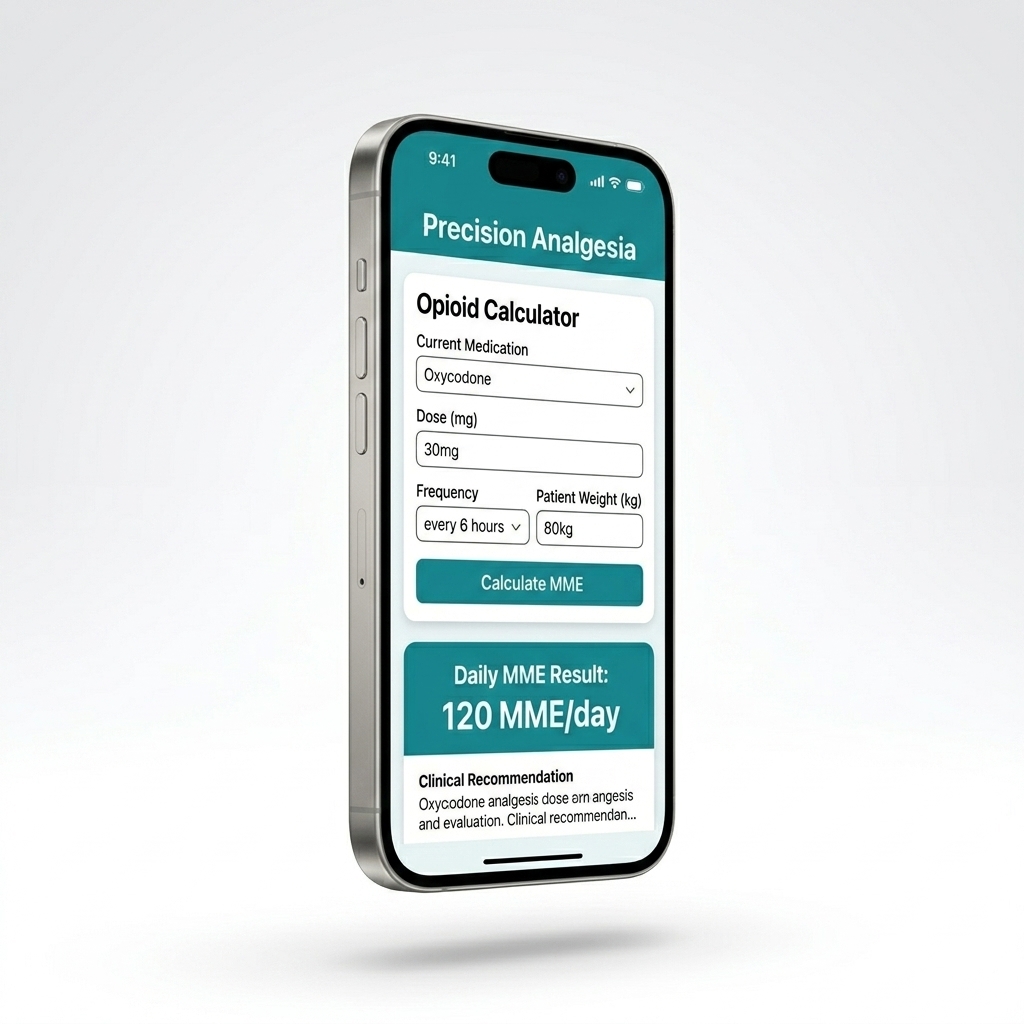
Precision Analgesia resolves the tension between pain management and safety. Replaces manual calculation with EMR-integrated forcing functions to mitigate liability and cost.
Opioid complications are no longer just clinical errors; they are existential legal and financial threats.
Annual System Burden
Opioid Use Disorder accounts for nearly 7.86% of all hospital expenditures. A single OIRD episode creates a $3,500 cost variance.
Undetected Risk
The PRODIGY Trial revealed 46% of floor patients experience respiratory depression. Manual nursing checks miss the vast majority of these events.
Corporate Negligence
Shift from malpractice to systemic liability. Recent verdicts (e.g., Asante Rogue) prove that "Failure to Monitor" is now a nine-figure threat.
A proprietary Clinical Validation Engine designed to sit between the clinician and the prescription via CDS Hooks. It eliminates "Alert Fatigue" by gating unsafe orders.
Passive alerts are ignored 90% of the time. Our engine defaults to AVOID for active metabolites (e.g., Morphine) when GFR < 30 — proceeding requires an explicit, documented acknowledgment of the evidence.
Identifies Child-Pugh Class C. Automatically adjusts bioavailability calculations for Hydromorphone (4x increase in liver failure) to prevent accidental overdose.
Replaces dangerous static conversion tables with non-linear pharmacokinetic modeling. Accounts for variable half-life to prevent accumulation toxicity and death.
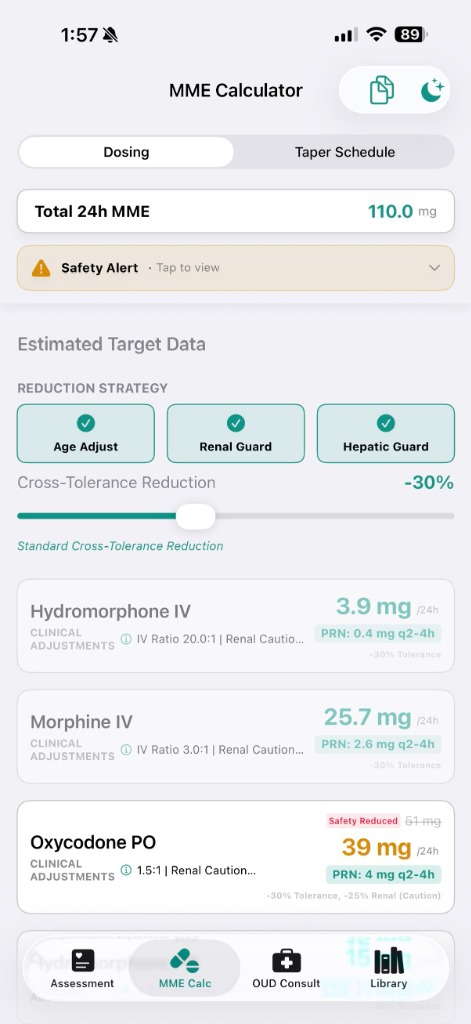
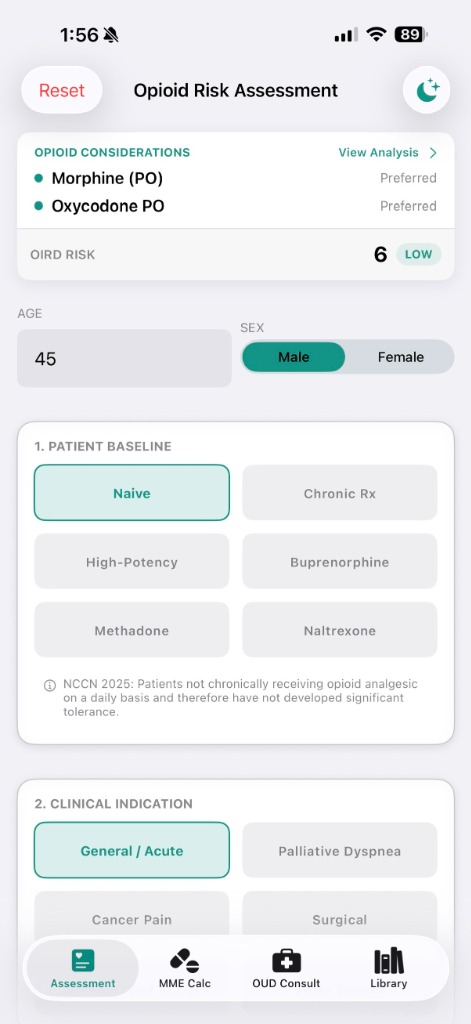
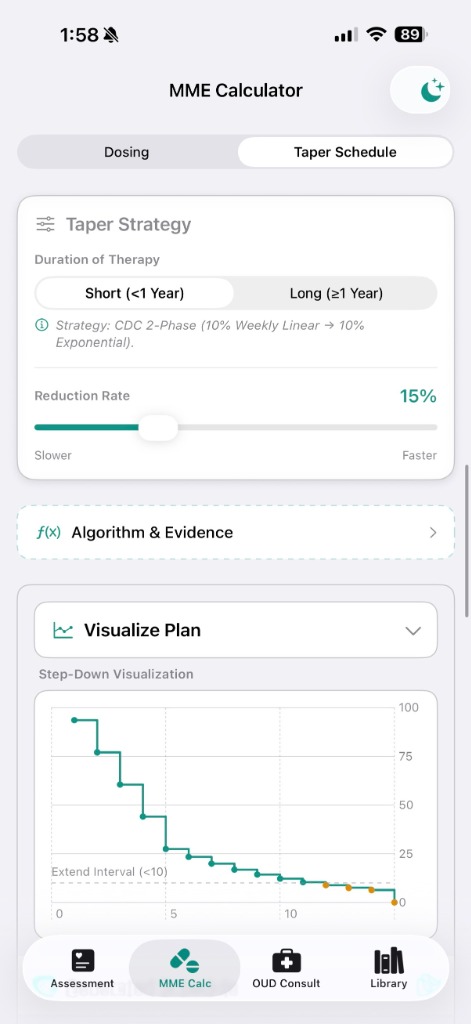
The same clinical validation engine that powers our EMR integration is available as a standalone iOS app. Use it at the bedside, in the pharmacy, or during rounds.
24-drug database with route-aware, organ-adjusted dosing and CDC 2022-validated cross-tolerance reductions.
PRODIGY-aligned OIRD scoring with auto-generated monitoring plans and organ-specific safety gating.
Integrated screeners (DAST-10, ASSIST-Lite), COWS-based induction protocols, and multimodal sparing options.
Swipe to view more screenshots
Three steps from clinician action to evidence-based recommendation — no additional training, no workflow disruption.
Physician clicks a button in Epic or Cerner. The EMR opens a secure SMART on FHIR session — either embedded in the chart or in a new window.
OAuth 2.0 token exchange authenticates the session. The app queries patient demographics, lab values (eGFR, LFTs, QTc), and current medications via FHIR R4.
App loads instantly with patient context pre-filled. Safety gates auto-execute, OIRD risk is scored, and the clinician receives gated, evidence-based recommendations.
When a clinician selects or signs an opioid order, Epic fires a CDS Hook to our service endpoint. The Precision Analgesia engine evaluates all 10 safety rules in real-time and returns actionable cards — warnings, dose adjustments, and alternative recommendations.
For critical safety gates (renal contraindications, pediatric black box warnings), hospital Epic teams configure Best Practice Advisories (BPAs) powered by our logic — creating true forcing functions that require clinical justification to override.
Age, sex, demographics
Renal, hepatic, pregnancy, COPD, OSA, CHF (ICD-10)
Creatinine/eGFR, LFTs, QTc interval (LOINC)
Active opioids, benzodiazepines, naltrexone (RxNorm)
From sandbox validation to live clinical deployment — a structured, low-risk rollout designed for enterprise health systems.
Register on Epic's developer portal. Build SMART on FHIR launch flow, implement FHIR R4 queries, validate CDS Hooks service endpoint against synthetic patient data.
Security risk assessment and HIPAA BAA execution with partner hospital. Epic staging environment configuration, clinical workflow review with pharmacy and nurse informaticists. Private SMART app registration — no Epic App Orchard / Integration Certification listing required for pilot.
Limited deployment on select medical-surgical floors. Real-world clinical validation with identified physician champions. Data collection and outcome tracking against baseline metrics.
Pilot expansion, Epic App Orchard / Integration Certification listing application, and broader system-wide availability. Continuous outcome tracking for ROI documentation and settlement fund reporting.
Evidence-based targets to substantiate claims for Opioid Abatement Settlement funds.
| Metric Category | Specific Measure | Target / Benchmark | Source |
|---|---|---|---|
| Equity | Racial Disparities (Black Pts) | Close the Gap (Current OR 0.83 vs White Pts) | 2024 Meta-Analysis |
| Clinical Safety | OIRD Rate | <0.5% of opioid-receiving inpatients | PRODIGY 13 |
| Prescribing | MME/Day at Discharge | <90 MME for opioid-naive patients | CMS 7 |
| Opioid Safety | High-Risk Prescribing | Reduction via active safety gates + required acknowledgment (vs. passive alerts) | Study 42 |
| Financial | Cost of OIRD Episode | Reduce variance (<$3,500 gap) | 24 |
Automated capabilities that transform clinical recommendations into enforceable EHR logic — no additional training required.
Identifies high-risk patients via PRODIGY-derived scoring and flags them for continuous capnography — turning positive ROI into automated workflow.
Enforces EHR defaults, safety acknowledgments, and order set constraints automatically — eliminating reliance on provider memory or education alone.
Built-in patient communication templates aligned with new HCAHPS scoring — maintain satisfaction while reducing MMEs.
Generates auditable logs of every forcing function and override, building a defensible record against "failure to monitor" and "corporate negligence" claims.
The era of unchecked opioid prescribing in hospitals is over, replaced by a data-driven, risk-aware approach. The most successful health systems are those that view opioid safety not as a compliance burden but as a quality and financial imperative. By balancing the moral imperative to treat pain with the ethical duty to do no harm, hospitals can navigate this complex landscape.